For a long time, I believed that being always available was a strength.
Replying quickly felt professional.
Being reachable at odd hours felt responsible.
Saying “yes” instantly felt like commitment.

Somewhere along the way, availability became a default – not a choice.
I didn’t consciously decide to be on all the time. It just happened. Messages before breakfast. Calls that spilled into evenings. “Quick questions” that quietly consumed entire blocks of focus. Even when I wasn’t working, my mind stayed on standby mode.
What I didn’t realise then was this:
Constant availability slowly erodes clarity, energy, and effectiveness.
When Availability Turns Into a Liability
The cost doesn’t show up dramatically at first. It’s subtle.
You start your day reacting instead of thinking.
Your attention fragments into small, shallow pockets.
You feel busy but oddly unproductive.
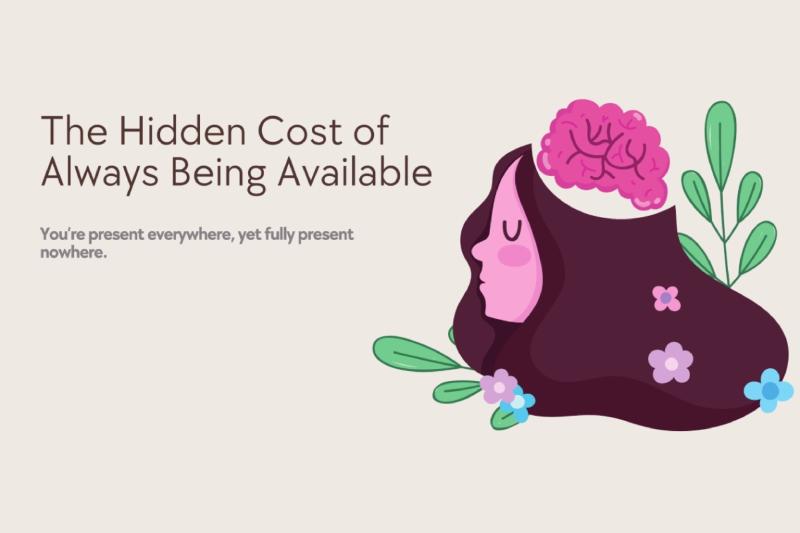
You’re present everywhere, yet fully present nowhere.
The irony is that no one explicitly demands this level of access. Most of the time, we create it ourselves. By responding instantly, we train others to expect instant access. Over time, boundaries disappear – not because they were crossed, but because they were never clearly drawn.
Eventually, the signs become harder to ignore:
- Mental fatigue even after “light” days
- Reduced creativity and strategic thinking
- Irritability without a clear cause
- A constant sense of urgency, even when nothing is urgent
Being always available doesn’t make you indispensable.
It makes you perpetually interrupted.
The Shift: From Reactive to Intentional
The change didn’t come from a dramatic decision or a burnout moment. It came from a simple experiment: pausing before responding.
Not ignoring messages.
Not withdrawing.
Just delaying.
I stopped replying immediately. I blocked focused time on my calendar. I allowed myself to be unavailable – without over-explaining.
Something surprising happened.
Work continued.
Conversations adjusted.
Most “urgent” matters resolved themselves.
What improved significantly was my ability to think clearly, prioritise better, and engage more meaningfully when I was present.
Availability creates the illusion of productivity.
Intentional presence creates real impact.
Key Learnings Along the Way

- Speed is not the same as effectiveness
Quick replies feel efficient, but deep work requires uninterrupted time. - Boundaries are taught, not declared
People follow the patterns you consistently demonstrate. - Being reachable all the time reduces your value, not increases it
Scarcity creates focus – both for you and for others. - Rest is not a reward
It’s a prerequisite for good decisions and creative thinking. - Silence is not neglect
Often, it’s respect for your own attention.
Practical Tips to Reclaim Your Time and Focus
If constant availability feels familiar, here are a few gentle but effective shifts:
- Introduce response windows
Decide when you check and reply to messages instead of doing it continuously. - Protect one deep-focus block daily
Even 60–90 minutes without notifications can dramatically improve output. - Stop apologising for delayed responses
A simple, calm reply sets a healthier norm than over-justifying. - Clarify what’s truly urgent
Most things aren’t. And the ones that are usually find a way to reach you. - Use availability intentionally
Be fully present when you are available – and fully unavailable when you’re not.
A Final Thought
Being available feels like care. And sometimes, it is.
But being intentional with your availability is what allows you to show up with clarity, energy, and purpose over the long run.
You don’t need to be everywhere.
You don’t need to respond instantly.
You don’t need to earn rest.
You just need to decide what – and who – deserves your attention. And protect it accordingly.